.jpg)
Session 11 – The Stress Cycle
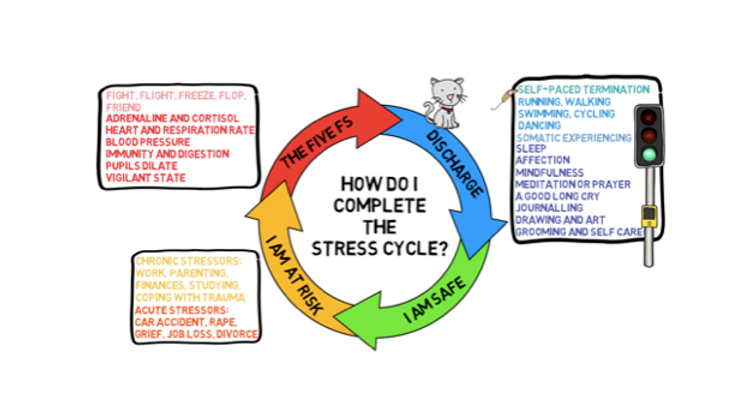
We often hear people say they want to know how to “deal with their stress”. But what science shows is that stress is a cycle.
This is the stress cycle. In order to deal effectively with stress we need to ask, “how do I complete the stress cycle?”
The cycle starts when we’re safe. Stressors in life lead us to be at risk. There are acute stressors, including car accidents, rape, grief, job loss and divorce, and chronic stressors, like workplace difficulties, parenting, financial pressure, studying or the challenges of coping with trauma. Chronic stressors are ongoing.
In order to deal with the risks these stressors cause, our body moves into fight, flight, freeze, flop, or friend. Our adrenaline and cortisol shoot up. Our heart rate, respiration rate and blood pressure rise. Our immune and digestive functioning is suppressed (which is why chronic stress can lead to stomach problems and autoimmune disorders), our pupils dilate and we shift to a vigilant state.
Once our body has responded, we need to discharge the stress. In nature, when a mouse is caught by a cat, it plays dead in order to survive. This is a freeze or flop response and happens with lots of animals. If the predator loses interest or is distracted, the prey will escape, shaking and juddering as it runs away. This shaking is known as “self-paced termination”, and enables the mouse to shake off the increase in adrenaline and cortisol, and recover from the trauma. In humans and domestic animals, self-paced termination doesn’t happen naturally: we have to create ways for it to take place.
There are other barriers we face as humans to discharging stress and completing the stress cycle. These include:
· That the body is not designed to be kept in an ongoing state of stress, as is the case for chronic stressors.
· Western culture with its “keep calm and carry on” attitude often leaves people feeling they are not allowed to admit things are difficult or take time to complete the cycle.
· The stressors can feel so overwhelming, that making space for them can leave us feeling scared that we will be swallowed up by them.
· Women particularly are socialised not to trust our bodies, so we may ignore the stress and try to keep going.
· Discharging the stress may involve being honest with those around us, requiring us to express feelings which may feel unsafe or socially inappropriate.
However, unless we make space to discharge the stress it will remain in our bodies. But it doesn’t have to!
Academic Emily Nagoski explains that: “Physical activity is the single most efficient strategy for completing the stress response cycle and recalibrating your central nervous system into a calm state.”
Whether through running, walking, swimming, cycling, dancing; physical exercise will make a huge difference and allows the body to discharge the stress. And there’s even a therapy that enables this to happen called somatic experiencing.
Other things that will help in discharging the stress include: sleep, receiving and giving affection, mindfulness, meditation or prayer, having a good long cry that leaves us feeling drained but like we have got stuff out, journaling, drawing and art, grooming and self-care.
By taking time to do these activities and recognising they are necessary for completing the stress cycle we are able to move back into knowing we are safe. It can take time, energy and support to do it, but we can move forward. We can complete the stress cycle.